
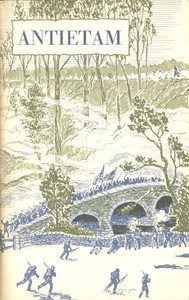
Antietam National Battlefield, Maryland by Frederick Tilberg
Frederick Tilberg's Antietam National Battlefield, Maryland isn't your typical history book. Written by the man who served as the park's historian for years, it feels less like a lecture and more like a guided tour from someone who knows every fence line and cornfield personally.
The Story
The book walks you through September 17, 1862, hour by hour, but from the ground level. Instead of just following generals, you're with the Union soldiers crossing the infamous Burnside Bridge under terrible fire. You're in the West Woods when Confederate reinforcements surprise the Union flank. You stand in the Sunken Road - later called Bloody Lane - as it fills with bodies. Tilberg shows how small decisions, misunderstood orders, and pure chance turned a planned Confederate retreat into the bloodiest single day in American history. The battle ends in a grim stalemate, but the aftermath chapters are where it gets really interesting - the stunned silence, the burial details, and how this tactical draw became a massive strategic shift for the whole war.
Why You Should Read It
What makes this special is Tilberg's perspective. He helped preserve this ground, so he knows which farmhouse walls still have bullet holes and exactly where artillery batteries were placed. He connects the landscape to the human experience. You get why soldiers struggled up certain ridges, how fences channeled attacks into killing zones, and what the Miller farm family saw from their porch. He makes you understand the battle through geography - something maps alone can't do. The writing is clear and direct, without romanticizing anything. The horror of Antietam comes through in simple facts and careful description.
Final Verdict
This is the perfect book for two kinds of people: anyone planning to visit Antietam (read it before you go, and the fields will speak to you), and anyone who thinks Civil War history is just about generals and dates. Tilberg shows it's about dirt roads, cornstalks, and ordinary people caught in an extraordinary day. At under 100 pages in most editions, it's not a commitment - it's a concentrated dose of understanding. Pair it with a battlefield map, and you've got the best virtual tour imaginable from someone who was there long after the guns cooled, making sure we wouldn't forget what happened in those Maryland fields.
This historical work is free of copyright protections. Knowledge should be free and accessible.
Ashley Martinez
5 months agoA brilliant read that I finished in one sitting.
Robert Davis
1 year agoI decided to give this a try based on a colleague's recommendation, the chapter on advanced strategies offers insights I haven't seen elsewhere. It definitely lives up to the reputation of the publisher.
Mary Jackson
2 years agoI appreciate the objective tone and the evidence-based approach.
Susan Miller
8 months agoHaving explored several resources on this, I find that the way it challenges the status quo is both daring and well-supported. It definitely lives up to the reputation of the publisher.



Mary Garcia
2 years agoHaving read the author's previous works, the evidence-based approach makes it a very credible source of information. I'm glad I chose this over the other alternatives.