
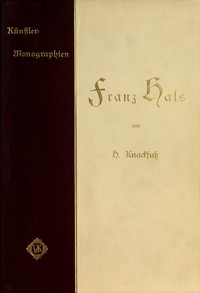
Franz Hals by H. Knackfuss
Published over a century ago, Hermann Knackfuss's Franz Hals is less a dry biography and more a guided tour through the life and work of one of art's great character observers. We don't get a novel-like plot, but we follow the dramatic arc of Hals's career: his rise in the bustling city of Haarlem, his fame for painting lively civic guards and witty tavern folk, and his later years marked by financial struggle. Knackfuss walks us through this story by connecting the dots between Hals's personal experiences and the revolutionary paintings he created.
The Story
The book outlines Hals's journey as an artist who chose to paint people as they really were. Instead of kings and saints, he painted local soldiers, fishwives, and children. His famous 'laughing' portraits are a big focus. Knackfuss shows us how Hals used loose, energetic brushstrokes to capture a fleeting smile or a sideways glance, making his subjects feel alive centuries later. The narrative also doesn't shy away from the harder parts: Hals's large family, his money troubles, and how his style fell out of fashion before being rediscovered. It's the story of an artist sticking to his vision, for better or worse.
Why You Should Read It
You should read this because it makes old art feel immediate and exciting. Knackfuss writes with a clear admiration that's contagious. After reading, you'll walk through a museum and spot a Hals from across the room—not because of the subject, but because of the energy. The book argues that Hals's real genius was his empathy. He saw the story in every face, from a wealthy merchant to a street musician, and gave them all dignity and spirit. It's a powerful reminder that great art is about connection, not perfection.
Final Verdict
This is a perfect pick for anyone curious about art history but intimidated by heavy textbooks. It's also great for painters or creatives interested in technique and artistic courage. Because it's an older book, the language is formal in places, but its core message is timeless: true artistry lies in seeing and celebrating the vivid, imperfect humanity in everyone. Keep your phone handy to look up the paintings as you read—it turns the book into a fantastic private gallery tour.
You are viewing a work that belongs to the global public domain. Thank you for supporting open literature.
Kenneth Martin
1 year agoWithout a doubt, the emotional weight of the story is balanced perfectly. Worth every second.
Mark Young
8 months agoClear and concise.
Linda Miller
1 year agoThe fonts used are very comfortable for long reading sessions.




Edward Wilson
11 months agoSurprisingly enough, the clarity of the writing makes this accessible. One of the best books I've read this year.