
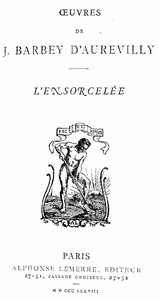
L'ensorcelée by J. Barbey d'Aurevilly
Okay, let's break this atmospheric beast down. 'L'ensorcelée' (which translates to 'The Bewitched' or 'She Who Was Bewitched') is a novel that wraps a personal tragedy inside a historical and supernatural mystery.
The Story
The heart of the tale is Jeanne Le Hardouey. She's married to a rough, practical farmer but feels utterly alone in her remote village. Her life changes when she encounters Abbé de la Croix-Jugan, a priest whose face was brutally slashed during the Chouannerie—a bloody royalist uprising against the Revolution. He's a walking wound, a living reminder of the region's violent past. Jeanne becomes fascinated by him, seeing in his suffering a depth her daily life lacks. Their intense, strange relationship fuels gossip. The villagers, still nursing the wounds of the failed rebellion, begin to murmur. Is Jeanne bewitched by the priest? Is he using dark powers? Or is she, and the whole region, simply haunted by the unresolved trauma of history? The story unfolds like a slow-burning fuse, leading to a shocking and tragic conclusion that blurs the lines between sin, sanctity, and madness.
Why You Should Read It
Forget simple ghost stories. What hooked me was how Barbey d'Aurevilly makes the landscape itself a character. The moors, the fog, the crumbling manor houses—they're all soaked in melancholy and memory. Jeanne's obsession isn't just about a man; it's a desperate search for meaning in a world that feels empty and cursed. The priest is a fantastic, ambiguous figure. Is he a saint bearing his scars, or a demon leading her astray? The book lets you decide. It's less about providing answers and more about making you feel the weight of the questions. It captures that eerie feeling when collective memory turns into local legend, and how past violence can poison the present.
Final Verdict
This book is perfect for readers who love mood over action. If you're into the brooding atmosphere of Emily Brontë's Wuthering Heights, the psychological depth of Hawthorne, or the decaying grandeur of Southern Gothic, you'll find a kindred spirit here. It's also a great pick for anyone interested in the messy aftermath of the French Revolution, seen from the forgotten corners of the country. Fair warning: it's not a fast-paced thriller. It's a slow, immersive, and haunting walk through a haunted landscape—both outside and inside the human heart. Come for the Gothic mystery, stay for the breathtakingly gloomy prose.
This book is widely considered to be in the public domain. Feel free to use it for personal or commercial purposes.
Amanda Johnson
1 year agoFive stars!




Mary King
1 year agoSolid story.