
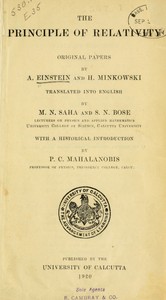
The Principle of Relativity by Albert Einstein and H. Minkowski
Okay, let's be clear: this is not a novel. There's no protagonist in the traditional sense, unless you count the human mind grappling with the cosmos. The 'plot' of this book is the unfolding of a radical idea. It collects key papers, including Einstein's 1905 paper on Special Relativity and Minkowski's later 1908 lecture where he introduced the game-changing concept of a four-dimensional spacetime.
The Story
The story begins with a simple, almost innocent question: What if the speed of light is always constant, no matter how fast you're moving? From that single premise, Einstein shows that crazy things must happen. Moving objects get shorter. Time stretches out. Mass and energy are two sides of the same coin. Then, Minkowski enters the scene. He takes Einstein's equations and reframes them not as a theory about objects moving in space and time, but as a description of a single, unified entity: spacetime. He gives us the powerful visual of a 'world-line,' the path an object traces through this four-dimensional continuum. The climax isn't an action scene, but a profound shift in perspective—the universe is not a stage with a separate clock; it's a dynamic, interconnected block where past, present, and future have a new relationship.
Why You Should Read It
You should read this not to become a physicist, but to witness a masterpiece of human thought. There's a raw, electric quality to reading the original arguments. You see the logic build, step by step. It's tough going in places—the math is real—but skipping to the explanatory text around the equations still gives you the core of the revolution. The real theme is the power of a new viewpoint. Minkowski's spacetime wasn't just new math; it was a new way of seeing. It made relativity intuitive in a way Einstein's original paper did not. Reading them together shows how science often works: one genius poses a paradox, and another provides the map to navigate it.
Final Verdict
This book is for the curious non-scientist who isn't afraid of a little intellectual heavy lifting. It's perfect for the reader who enjoyed a biography of Einstein and wants to see the source material, or for anyone who's ever looked up at the stars and felt a deep wonder about how it all actually works. It's not a light read, but it is a profoundly rewarding one. You won't finish it an expert, but you will finish it with a genuine sense of how two people changed our place in the universe forever.
This work has been identified as being free of known copyright restrictions. Distribute this work to help spread literacy.
Donna Anderson
1 year agoMy professor recommended this, and I see why.
Linda Moore
1 year agoRead this on my tablet, looks great.

Noah Ramirez
8 months agoUsed this for my thesis, incredibly useful.